
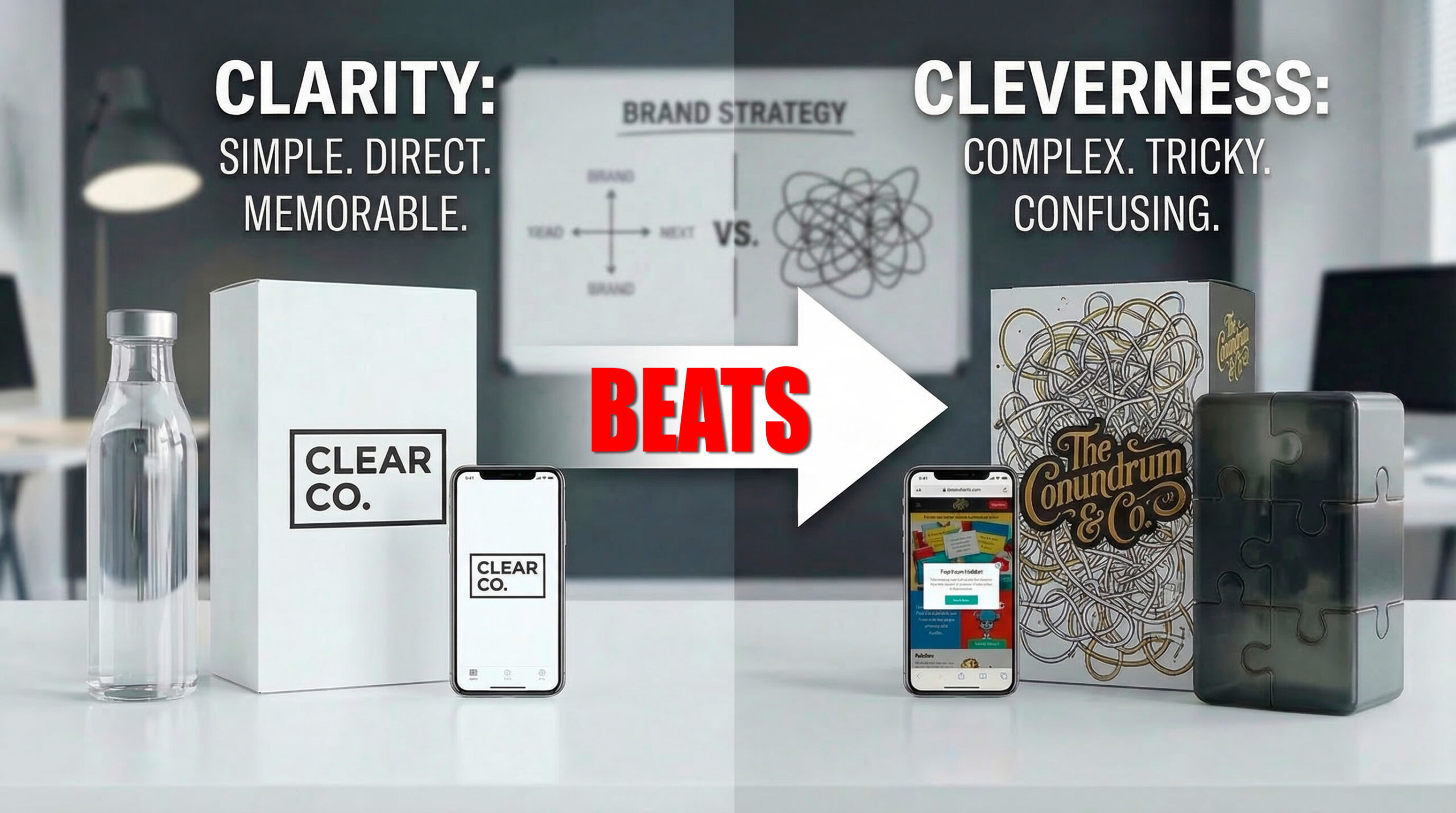
In the early stages of building a brand, many founders and creators make the same mistake: they try to sound clever instead of clear.
They invent creative taglines.
They use abstract language.
They position their work in complicated ways that feel unique.
But the problem with clever branding is simple.
If people don’t understand what you do in seconds, they move on.
In a digital world where attention is limited and choices are endless, clarity beats cleverness every time.
If your brand is confusing, it won’t make money.
Why Complicated Brands Struggle to Grow
Complicated branding creates friction.
When a potential customer encounters your website, social profile, or content, their brain asks one immediate question:
What does this person or company actually do?
If the answer is not obvious, people rarely spend time trying to figure it out.
Instead, they leave.
This is known as cognitive load — the amount of mental effort required to understand something.
Research from the Nielsen Norman Group consistently shows that users prefer content and messaging that is easy to scan and immediately understandable.
When a brand’s messaging is complex, visitors must work harder to interpret it. That extra effort often kills engagement and conversions.
Signs Your Brand Messaging Is Too Complicated
Many brands unintentionally make their messaging harder to understand than it needs to be.
Common signs include:
- Vague mission statements
- Buzzwords that mean different things to different people
- Long explanations of what you do
- Multiple services competing for attention
- Taglines that sound clever but lack meaning
For example, compare these two statements:
Complicated messaging
“We empower visionary professionals through innovative digital transformation frameworks.”
Clear messaging
“We help coaches turn their expertise into profitable online courses.”
The second message is instantly understandable.
And clarity drives action.
Why Clear Messaging Converts Better
Clear messaging works because it answers three critical questions immediately:
- What do you do?
- Who is it for?
- What problem do you solve?
When people instantly understand your value, they are far more likely to stay, follow, and eventually buy.
According to research from HubSpot, brands with clear positioning and messaging create stronger trust and higher conversion rates because audiences know exactly what to expect.
Clarity removes hesitation.
And hesitation is the enemy of sales.
The Clarity Advantage
Clear brands benefit in several ways:
| Benefit | Why It Matters |
|---|---|
| Faster understanding | People instantly know what you offer |
| Stronger positioning | You become associated with a specific solution |
| Higher conversions | Clear value makes decisions easier |
| Better referrals | Customers can easily explain what you do |
When messaging is simple, your audience can repeat it.
And repeatable messaging is how brands grow.
How to Simplify Your Brand Positioning
Simplifying your brand messaging does not mean making it boring.
It means making it obvious.
The best brands focus on communicating value in the simplest possible language.
Step 1: Define the Problem You Solve
Every successful brand solves a specific problem.
Instead of describing your process or methodology, focus on the outcome you deliver.
Examples:
- “We help SaaS companies increase product adoption.”
- “I help freelancers build six-figure service businesses.”
- “We help founders build profitable personal brands.”
When the problem is clear, the value becomes obvious.
Step 2: Identify Exactly Who You Help
Trying to appeal to everyone weakens your message.
Clear brands are specific about their audience.
For example:
| Vague Audience | Clear Audience |
|---|---|
| Entrepreneurs | First-time SaaS founders |
| Creators | YouTube educators |
| Coaches | Fitness coaches building online programs |
Specific audiences make your brand easier to understand and easier to trust.
Step 3: Focus on the Transformation
Your brand is not defined by what you do.
It is defined by what changes for your customer.
The most powerful positioning communicates a before-and-after transformation.
For example:
| Weak Positioning | Strong Positioning |
|---|---|
| “Marketing consultant” | “I help startups get their first 1,000 customers.” |
| “Business coach” | “I help freelancers turn skills into scalable agencies.” |
| “Content strategist” | “I help founders grow authority through LinkedIn.” |
Transformation is easier to understand than services.
Step 4: Test the Five-Second Rule
A simple test can reveal whether your brand messaging is clear.
Ask someone to read your headline or bio for five seconds.
Then ask them:
What does this brand do?
If they struggle to answer, your messaging needs simplification.
Clear brands pass the five-second test.
Examples of Brands That Win With Clarity
Some of the most successful brands in the world use extremely simple messaging.
Slack
Slack’s positioning is direct and understandable:
“Where work happens.”
The message communicates collaboration, communication, and workplace productivity in three words.
You immediately understand the purpose.
Stripe
Stripe’s messaging focuses on a clear value proposition:
“Financial infrastructure for the internet.”
Developers and businesses instantly understand that Stripe helps them process payments and manage financial systems online.
Personal Brand Example
Compare these two positioning statements:
Clever but unclear
“I help visionaries unlock their digital potential.”
Clear
“I help creators build profitable personal brands.”
The second statement is easier to understand, easier to remember, and easier to trust.
The Hidden Power of Simplicity
The brands that scale the fastest are rarely the most clever.
They are the easiest to understand.
Clear messaging allows your audience to:
- Instantly recognize your value
- Explain your brand to others
- Remember what you do
- Decide quickly whether they need your solution
Clarity is not just a branding choice.
It is a growth strategy.
When your message is simple, your audience grows faster and your offers convert more easily.
Final Thoughts
Many founders and creators try to differentiate themselves by sounding more sophisticated or creative.
But in branding, simplicity almost always wins.
People do not reward brands for being clever.
They reward brands for being clear.
If your audience cannot immediately understand what you do and how it helps them, they will not stay long enough to discover your brilliance.
So when in doubt, simplify.
Because the brands that make the most money are rarely the most clever.
They are the easiest to understand.